Analyzer
The Analyzer algorithm aims at testing an Experiment, computing a probability table between input states
and expected outputs, a performance score and an error rate, through a given Computer
For example, we call the Naive backend that we store in simulator_backend:
>>> simulator_backend = pcvl.BackendFactory().get_backend('Naive')
We can create an input state that will enter our optical scheme later on. We store it in input_state and use BasicState from the Perceval library.
>>> input_state = pcvl.BasicState("|1,1>")
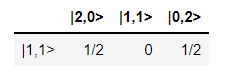
let’s simulate the distribution obtained when we input two photons in a beam-splitter. We will use the Naive backend already stored in simulator_backend.
We will simulate the behavior of the circuit using the Analyzer which has four arguments:
The first one is an instance of the computer that we are going to use.
The second one is the experiment to analyse.
The third one is the input state (we will use input_state).
The fourth one is the desired output states. To compute all possible output states, one just input “*”.
>>> experiment = pcvl.Experiment(pcvl.BS())  # No need to declare the input state here
>>> computer = pcvl.SimulatedComputer(simulator_backend)
>>> with computer.acquire():
...     ca = pcvl.algorithm.Analyzer(computer, experiment, [input_state], "*")
Then, we display the result of Analyzer via pdisplay.
>>> pcvl.pdisplay(ca)
- class perceval.algorithm.analyzer.Analyzer(computer, experiment, input_states, output_states=None, mapping=None, **kwargs)
Analyzes a set of input states vs output states probabilities.
- Parameters:
computer (
AComputer) – the Computer on which to launch the testsexperiment (
Experiment) – the Experiment to analyzeinput_states (
list[BasicState] |dict[BasicState,str]) – list of FockStates or a mapping {FockState: name}output_states – list of output states. Valid values are: * None (then, the input states are taken as output states) * a list of FockState * a mapping {FockState: name} * the string “*” meaning oll possible target states are generated
mapping – optional mapping {FockState: name} used for display
kwargs – as the Analyzer internally uses an ExecutionFactory, it needs a “max_shots_per_call” value
- col(output_state)
Return the column number for a given output state in the distribution matrix
- Parameters:
output_state (
BasicState) – any computed output state- Return type:
Optional[int]- Returns:
the column number, or None if the output state is unknown
- compute(normalize=False, expected=None, progress_callback=None)
Iterate through the input states, generate (post-selected) output states and calculate distance with expected, if provided.
- Parameters:
normalize (
bool) – whether to normalize the output statesexpected (
Optional[dict]) – optional mapping between states in ideal caseprogress_callback – optional callback to inform the user of the task progress